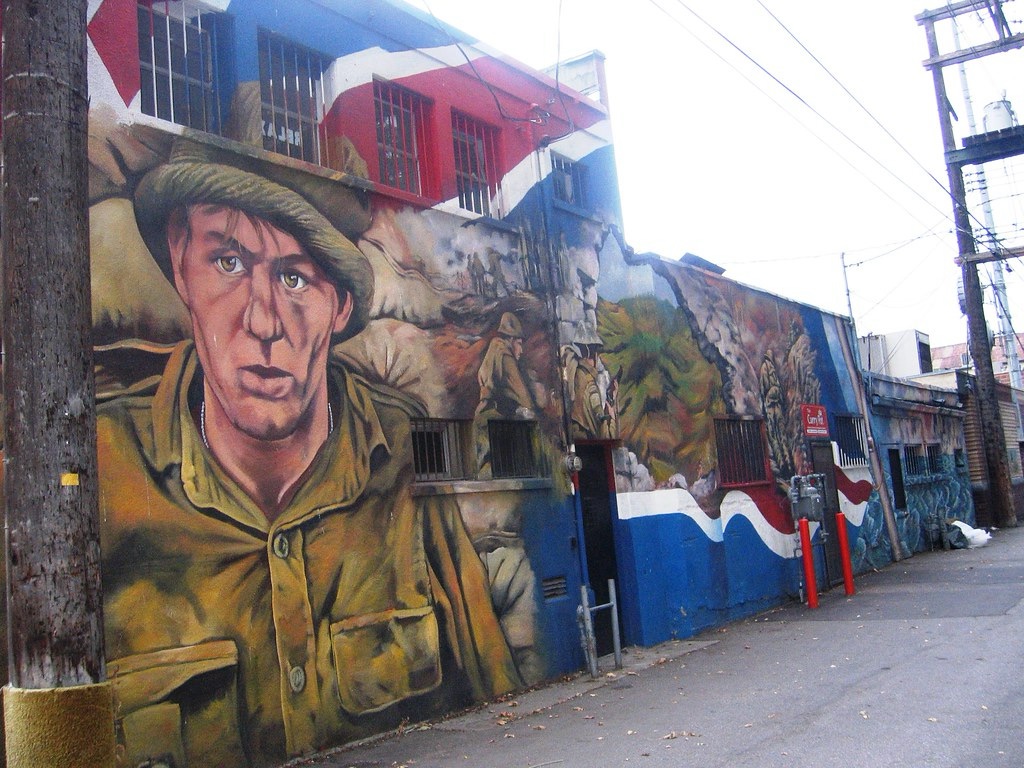
The Faces on the Legion Wall
The wall belonged to Branch 47 of the Royal Canadian Legion, and for thirty years it had been the colour of weak tea.
Nobody remembered choosing it. It just was, the way the hall’s carpet was, and the way the coffee urn hissed at ten past every hour.
Michelle arrived in late August with a ladder strapped to her truck and four hundred dollars of exterior primer in the back. The branch had raised the money over two winters of meat draws and pie auctions. They wanted, as the president put it in his careful letter, something worthy of the ones they’d lost, and the ones they still had.
She had painted forty-some murals in her life. Salmon runs, grain elevators, a steam locomotive that children in one town still swore could move. But she had learned, slowly and sometimes painfully, that a mural for a community is not really yours.
You hold the brush. They hold the meaning. Her job was to listen until she could tell the difference.
So on the first morning she didn’t paint at all. She set up a folding table by the wall with a thermos, a notebook, and a hand-lettered sign: Tell me who should be here.
By noon she had eleven names. By the end of the week she had sixty-three, and a shoebox of photographs that people had pressed into her hands as though handing over something alive.
Walter
He came on the ninth day, in a cardigan buttoned wrong, leaning on a cane with a rubber foot that squeaked on the pavement. He didn’t say hello. He looked at the primed wall, white now and enormous, and said, “You’ll want to start with the sky.”
“Why’s that?”
“Because that’s what they all looked at last.” He lowered himself onto the bench beside her table. “Or first. Depending how you count.”
His name was Walter Dunn. He was ninety-four. He had gone to Korea at nineteen and come back at twenty-one, and he didn’t say much about the years in between.
He came every day after that. He brought his own coffee, because he said the Legion’s tasted like a boot. He sat and watched her grid the wall into squares and sketch the first faces in charcoal, and he corrected her uniforms. Collar’s wrong for ‘51. Those boots came later. He was nearly always right. When he wasn’t, he admitted it with a grudging little nod that Michelle came to love.
She painted the sky first. It was a wide, rinsed blue, going pale at the horizon, the way it does over the hills in October.
Walter watched it dry and said nothing for a long time. Then: “That’s close.”
The Faces
The mural grew from the edges inward. Michelle left a space at the very centre empty, and when people asked who would go there, she said she didn’t know yet. A nursing sister from the First World War came first, taken from a photograph so faded Michelle had to guess the colour of her eyes. The woman’s great-niece told her: Grey. Everyone in that family has grey eyes. A Métis sniper’s grandson drove two hours each way to watch his grandfather’s face rise up out of the plaster. A peacekeeper in a blue beret, Cyprus, 1974, had a daughter who stood at the foot of the ladder and cried without making any sound at all. A young corporal from Afghanistan was painted from a phone picture, grinning, with a cigarette tucked behind his ear. His mother asked Michelle, laughing and wiping her eyes, to please leave the cigarette in.
People started bringing lawn chairs. A girl from the high school asked if she could help. Michelle gave her the job of mixing greens, and then the job of painting poppies along the bottom edge. There were hundreds of them, each one slightly different, because the girl insisted that no two people were the same, so no two poppies should be either.
Michelle worked from dawn until her shoulders gave out. At night she lay in the motel and saw faces on the ceiling.
And every day, Walter sat on his bench.
The One Without a Photograph
It was the third week of September when he finally asked.
“There’s a fellow,” he said. “Not on your list.”
Michelle opened the notebook. “Tell me.”
“Danny Kowalchuk. Dairy farm, out past Armstrong. A year younger than me. Same section.” Walter turned his cup in his hands. “He didn’t come back. His people are all gone now. There’s no picture. I looked.” A pause. “I’ve looked for seventy years.”
Michelle set down her pencil. “Then you’ll have to be the picture.”
So they began. Every morning for a week, before she touched the wall, Walter described him. Danny had a wide face, too wide for his helmet, so it always sat pushed back on his head. He had a chipped front tooth from a hockey puck, ears like a jug, a hell of a lot of freckles, and hair the colour of a wet fox. He laughed with his whole body. He couldn’t carry a tune and sang anyway.
Michelle drew, and Walter shook his head. She drew again. Eyes further apart. No, smaller. He was always squinting, like he was about to tell you something. She drew a fourth time, and a ninth. Some mornings he was tired and said only, “Not today,” and she let it be.
On the eleventh try, Walter went very still. He put out one shaking hand toward the sketchbook, but he didn’t touch it.
“There he is,” he said quietly. “There’s the bugger.”
Michelle painted Danny Kowalchuk in the empty space at the centre of the wall, larger than any other figure, helmet pushed back, squinting into the light as though he were about to tell you something. She gave him the chipped tooth. She gave him every freckle she could fit.
Korea had always been called the forgotten war. Now it had a face, and that face sat in the middle of everything.

The Eleventh of November
They unveiled it on Remembrance Day.
The morning was cold and very clear. The whole town seemed to come, and some of the next town over. The pipe band played. The children laid their paper wreaths. At eleven o’clock the silence came down over the crowd like snow, and in it you could hear the flag rope ticking against the pole.
When the cloth came off, people didn’t clap right away. They looked for their own: fathers and great-aunts and sons. When they found them, they reached for each other’s hands. The peacekeeper’s daughter put her palm flat against her father’s blue beret. The corporal’s mother laughed at the cigarette. The girl who had painted the poppies stood with her arms crossed tight, trying very hard not to look proud.
Walter asked to be taken closer. Two cadets helped him across the grass, one on each arm, and stood him at the foot of the wall. He looked up past the nursing sister and the sniper and the young man from Kandahar, to the face at the centre of the wall.
Danny squinted down at him.
Walter raised his hand to his brow. It wasn’t a regulation salute, because his arm wouldn’t go that high anymore. But he held it there a long moment, and Michelle, standing a few feet back, saw his lips move.
She never asked what he said. Some things on a wall are for everyone. Some are only for one person, and the painter’s job is to make room for them, and then step away.
After
Walter Dunn died the following spring, in April, in his sleep.
The Legion held the reception in the hall. Afterward people drifted outside with their coffee, which still tasted like a boot, and stood in front of the wall. Someone had tucked a single poppy into a crack in the mortar just below Danny’s face. Then someone else did the same beneath it. By evening there was a small red line running down the wall, and nobody could say who had started it.
Michelle drove up from the coast the next week. She brought one small can of paint and climbed the ladder. In the blue just above Danny’s shoulder, so faint you’d only see it if you knew to look, she painted a second figure: an old man in a cardigan buttoned wrong, his face turned up toward the blue.
She thought about whether that was hers to do, and decided that it was, just this once.
Then she came down the ladder, packed her brushes, and let the wall belong to the town again.





Leave a Reply