In 2013, in Vernon, British Columbia, a group of advocates launched The Sunflower Project.
It did not begin as decoration.
It began with a history Canada had struggled to speak about.
From 1914 to 1920, during Canada’s first national internment operations, thousands of men, women and children were branded “enemy aliens.” A majority of those affected were Ukrainians. 8,579 people were interned, while tens of thousands of others were required to register and report to authorities.
Vernon was one of those internment locations. And visionary in its inclusion in the heritage narrative of human rights! Its camp opened on September 18, 1914, and remained open until February 20, 1920.
That history is not somewhere else.
It happened here.
And for my family, it was not simply something found in an archive.
I am an internee descendant. The story passed through my family included my great grandfather searching throughout his life for his brother. Records eventually identified my great-uncle as POW #47, interned at Banff/Castle Mountain.
That silence between generations is one of the reasons The Sunflower Project exists.
A sunflower became a way to remember
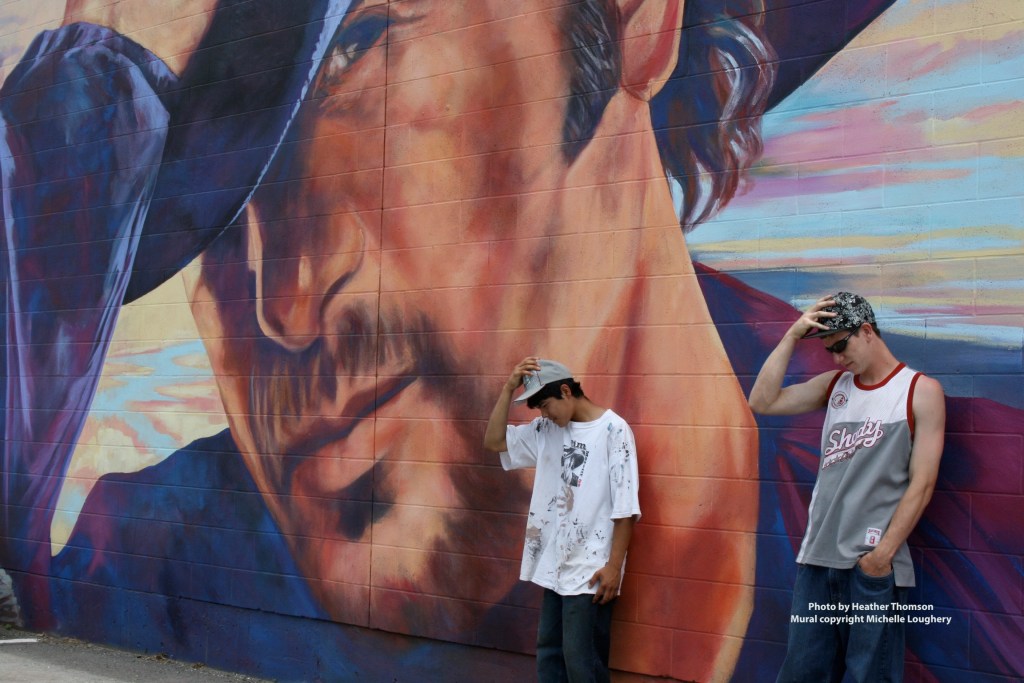
The project was nationally launched in Vernon on February 20, 2013 as an internment mural and public education initiative. It brought together art, historical photographs, family stories, schools, community members and descendants.
The sunflower became more than an image.
It became a wayfinder.
A way back to stories that had almost disappeared.
A way for families to say: we were here.
A way for young people to encounter difficult Canadian history not only through dates and documents, but through faces, colour, public space and conversation.
The Canadian First World War Internment Recognition Fund itself was established following an agreement between the Government of Canada and representatives of the Ukrainian Canadian community to support projects that commemorate and educate Canadians about these internment operations.
That makes public remembrance important.
But it also makes participation important.
When is silence erasure?
This is where the question of erasure enters the conversation.
Erasure does not always mean somebody physically destroys an archive or paints over a name or a public monument! Although that has been happening to my community led histories.
Sometimes erasure is quieter.
It happens when a history is acknowledged ceremonially but the people carrying that history are no longer invited into the room.
It happens when governments, institutions or heritage organizations make decisions concerning cultural memory without meaningfully engaging the descendants, artists and communities who have spent years preserving it.
It happens when a community-created project becomes separated from the people, relationships and lived experience that created it.
And it happens when history gets reduced to an object instead of being understood as a continuing public responsibility.
A refusal to meet does not, by itself, prove deliberate historical erasure.
But when government has been presented with credible evidence of an important internment legacy and will not engage with those bringing that history forward, there is a real risk of institutional erasure through omission.
That distinction matters.
The Sunflower Project is living memory
The Sunflower Project was never intended to freeze history in 1914.
Its purpose was to use what happened then to create conversations about human rights, cultural history and social responsibility now. That purpose was stated at its national launch in Vernon in 2013.
It continued.
In 2022, the Canadian First World War Internment Recognition Fund’s Endowment Council came to Vernon for the opening of a national internment art exhibition hosted with Gallery Vertigo and the Wayfinder Sunflower Project.
The project therefore has a documented public history.
It has descendants.
It has community partners.
It has national internment connections.
It has educational purpose.
And it has a place in Vernon’s own history.
This is why consultation cannot simply be treated as a courtesy.
The process is part of the heritage.
We are not erasable
The lesson of Ukrainian Canadian internment is not simply that an injustice occurred more than a century ago.
The lesson is what can happen when people’s identities are defined by institutions instead of by themselves; when voices disappear from official narratives; and when silence becomes easier than confronting an uncomfortable history.
The sunflower pushes against that silence.
Every mural, photograph, document, descendant story and community conversation says the same thing:
We were here.
This happened here.
Our families remember.
Our communities remember.
And we are not erasable.
Governments do not have to agree with every interpretation of history.
But when a documented community history is brought forward, they should be willing to hear it.
That is not asking for special treatment.
That is what responsible heritage stewardship looks like.
The Sunflower Project began by bringing a buried Canadian story into public view.
Its work today is just as important:
to make sure it is never pushed back into silence.







Leave a Reply