Born in a coal mining town carved into the mountains of British Columbia, Michelle Loughery was raised on the heartbeat of working hands and the songs of those who had little but gave everything. Her story begins not in galleries or studios, but in the dust and shadow of industry—where immigrants toiled, where grandmothers wove stories into every stitch, and where the walls of towns stood silent, waiting for someone to make them speak.
Michelle was that someone.
She carried with her not only a brush but a vision—one born of watching the people around her build a country while their own stories were left behind. From the miners who disappeared into the dark for twelve-hour shifts, to the women who turned kitchens into classrooms of culture, Michelle saw history in every wrinkle, every song, every pair of worn boots. And she made it her life’s work to turn that history into art.
She began painting murals that weren’t just beautiful—they were sacred. Each one told a story that would have otherwise been forgotten. She painted the faces of immigrants, the hands of tradespeople, the strength of women, and the music of the working class. These were not fictional heroes—these were real people, rooted in real communities. Through Michelle’s eyes, they became legends.
But she dreamed even bigger.
What if these stories didn’t live only on one wall, in one town? What if the very highways that connected these communities could also connect their histories, their voices, their art? And so, she created the Wayfinder Project—a living, breathing art trail stitched across provinces, across nations, across borders. A mural movement rooted in public art, youth training, reconciliation, infrastructure, and the spirit of those who built Canada from the ground up.
From Sparwood to Vernon, from Merritt’s Country Music Capital murals to the legacy walls of Cuba, Missouri, Michelle connected dots like a constellation—a map of memory, song, and soul. Her art began to wrap around highways like ribbons of light, turning rural routes into global galleries.
She painted not just the images of people, but the feeling of being human: the weariness of work, the ache of migration, the hope of a new beginning. Her brush gave voice to the blue collars, the dreamers, the elders, the rebels, and the youth.
The Wayfinder Art Legacy became more than a mural model. It became a highway of healing.
A place where reconciliation isn’t just a policy—it’s painted on a wall for children to see.
A place where the forgotten are remembered.
A place where the road doesn’t divide us—it connects us.
Today, Michelle Loughery’s legacy is not confined to frames or awards. It rides the wind on every stretch of highway that holds one of her murals. It echoes in the music of those she honoured. It whispers through communities that once felt invisible, now lit by the power of their own reflection.
She didn’t just build a trail of art.
She built a route to belonging.
A roadway of remembrance.
A highway of dreams.
Michelle Loughery is not just an artist.
She is a Wayfinder.
And she has given us all a map back to who we are.
The Walls That Remember
In the early morning mist of a small Canadian mining town, the clink of boots on gravel echoed like a drumbeat of survival. Men and women, many with accents thick with history, stepped out of modest homes—calloused hands carrying metal lunch tins, hearts carrying the weight of faraway homelands. They were the immigrants. The builders. The blue collars. Their stories were not told in books. Their names weren’t carved in marble. But their sweat shaped this country, brick by brick, tunnel by tunnel.
They came from Italy, Ukraine, the Philippines, India, Portugal, Poland—hope stitched into their pockets like old love letters. They worked in the mines, deep beneath the surface of the earth, where the sun did not reach but dreams somehow still did. They laid track through frozen mountains, dug coal from beneath rivers, smelted iron in blistering heat, and soldered steel beams that would hold up cities. Women sewed, cooked, cleaned, nursed, and welded, balancing babies on hips and hope in their hearts.
Their backs bore the weight of Canada’s progress, their hands built the schools, bridges, and factories we now pass by without a second thought. Their children were told to assimilate, to forget the language of their grandparents. But the grandparents whispered it anyway—over soup, over song, over stories told in low light when the power bill had to wait.
Then came Michelle Loughery.
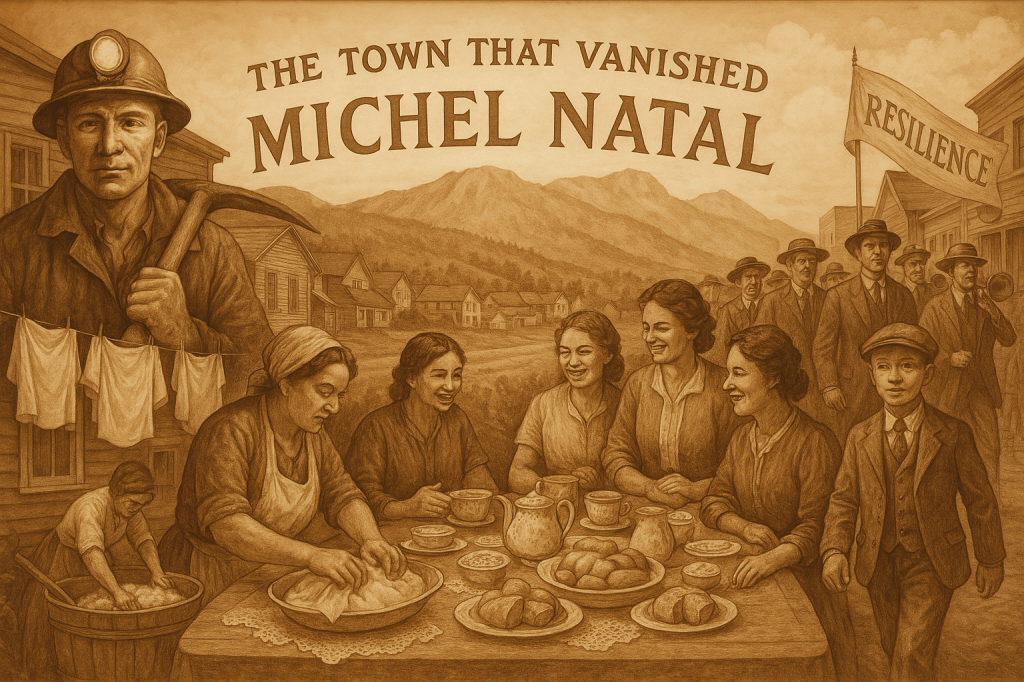
She saw them—not just their labor, but their legacy. She saw the beauty in their struggle and painted it on the walls of the towns they built. Her murals didn’t just color brick and mortar—they gave it memory. She turned faded black-and-white photographs into towering images that weep and sing. The woman sweeping her stoop. The miner with tired eyes. The boy holding his mother’s hand, looking forward, always forward.
Through Loughery’s art, the walls of these towns became storytellers. The murals speak in the tongues of those who laid the first rails, dug the first ditches, built the first communities. They whisper: We were here. We mattered.
And now, those walls stand not just for decoration, but for remembrance. They remind us that Canada’s strength comes not from glass towers and shiny boardrooms, but from the dust-covered boots and worn overalls of those who came with little and gave everything.
In every brushstroke, there is love. In every line, there is labor. In every color, there is courage.
These murals are not just art.
They are history.
They are heart.
They are home.
Michelle Loughery didn’t just paint walls—she uncovered the soul of a nation.
The Songs Beneath the Dust
Michelle Loughery didn’t stop at painting the faces. She listened, too. She listened to the hum in the silence, the echo in the alleyways, the songs that never made it to radio but lived in kitchens, mine shafts, and union halls. The music of Canada’s working people—the immigrant musicians, the hidden singers, the kitchen strummers—was there all along, buried beneath layers of coal dust, time, and sacrifice.
In the mining towns and railway camps, long before Spotify or stage lights, music was survival. After 12-hour shifts underground, men would gather with dented guitars, mandolins, and accordions. They sang in broken English and full hearts. Songs about missing home. Songs about the cold. Songs about love that waited across oceans and paycheques that barely stretched. Women sang lullabies over boiling pots, harmonized while folding laundry, played piano in church basements. They passed melodies down like heirlooms—music born of longing, belonging, and the in-between.
Loughery found that music, just like she found the faces. She painted not only what we could see, but what we could hear. And in towns like Merritt, she did something extraordinary—she made sure the music wasn’t forgotten.
She called it the “Musician’s Wall.” But it was more than that. It was a cathedral of country, folk, and blues—murals of the stars who rose from dust and stage smoke. They were the troubadours who grew up poor, singing immigrant heartache with a twang and truth. Some went on to win awards. Some never made it past the barroom stage. But Loughery put them all on the wall, side by side—equal in voice, equal in story.
She painted Canadian legends who grew up playing on porches, honky-tonk heroes who played for tips and pride, and unknown elders who carried whole histories in their throats. She showed us that Canadian music wasn’t born in studios—it was born in hardship, resilience, and kitchen jam sessions.
Through her work, Loughery created a visual symphony. A bridge between mural and melody. She brought to life the invisible harmonies of our nation’s soul: the Croatian grandfather who fiddled after his shift, the Métis auntie who sang her grandchildren to sleep, the Irish laborer who strummed away his grief, the Punjabi trucker whose songs kept him company on endless highways.
She made murals that sang. And towns listened.
In places like Cuba, Missouri and the backroads of British Columbia, the stories of Canada’s musical backbone now live on walls that hum with memory. Her art turned every passerby into a listener. And in that listening, we remember.
Michelle Loughery did not just tell the stories of those who built Canada with their hands. She told the stories of those who healed it, lifted it, and carried it with their voices.
And in her murals, the music plays on.
The Thread of the Highway
Michelle Loughery saw what others didn’t. While many saw roads as lines on a map, she saw lifelines—threads in a great, unseen tapestry that connects us all. She saw the highways not as concrete, but as storylines—routes of migration, labor, love, and longing. Roads where the music echoed from truck radios and harmonicas. Roads where families left one home to build another. Roads that wound through the heart of a country and the soul of a people.
Each mural she painted wasn’t just an artwork—it was a knot tied in that grand tapestry. From Vernon to Merritt, from Sparwood to Cuba, Missouri, she stitched stories across towns like embroidery on the land. And just like that, these places were no longer isolated. They became waypoints on a human journey. Towns turned into verses of the same song. Murals turned into visual stanzas—each one humming with culture, memory, and meaning.
She called it the Wayfinder Project, but what she really created was a map of belonging.
The highways were veins of memory, flowing with the stories of immigrants and workers, artists and elders, mothers and miners. And as she painted, Michelle didn’t just tell local stories—she told our story. The universal one. The one that connects the coal miner in British Columbia to the railway worker in China. The musician in Nashville to the mother singing in a Syrian refugee camp. The threads of humanity, running across borders like veins under skin.
The murals became portals—through them, we could see the child in the braid carrying a paintbrush instead of bitterness. The old man with a guitar, singing not for fame, but so the ache in his chest had somewhere to go. The highway became not just a route—but a rhythm.
In Loughery’s vision, the road is sacred.
It’s the migratory trail of our ancestors.
It’s the fur trade route, the buffalo path, the Underground Railroad, the Trans-Canada Highway.
It’s every journey we’ve made to survive, to create, to connect.
It’s the digital highway now, too—voices carried on wires, roots carried in code.
She painted a world in motion—and motion is life.
Each mural is a stop on a global migration of stories. A chorus in the song of us. Through her work, Michelle Loughery turned towns into storytellers, roads into symphonies, and walls into windows. And she reminded us that we are all traveling—threaded together, across time, across borders, across generations.
We are the tapestry.
We are the road.
We are the song.
 ARTIST MICHELLE LOUGHERY
Leave a comment